1. William Dalrymple, City of Djinns. Penguin Books, 1994.
 Sparkling with irrepressible wit, City of Djinns peels back the layers of Delhi's centuries-old history, revealing an extraordinary array of characters along the way-from eunuchs to descendants of great Moguls. With refreshingly open-minded curiosity, William Dalrymple explores the seven "dead" cities of Delhi as well as the eighth city-today's Delhi. Underlying his quest is the legend of the djinns, fire-formed spirits that are said to assure the city's Phoenix-like regeneration no matter how many times it is destroyed. Entertaining, fascinating, and informative, City of Djinns is an irresistible blend of research and adventure. www.amazon.com
2. Verrier Elwin. The Tribal World of Verrier Elwin. Oxford University Press, New York and Bombay. 1964.
While a student at Oxford, Verrier Elwin (1902-1964) took keen interest in the Indian culture. He was a devout Christian and underwent formal training as a missionary. He came to India 1927 to spread the gospel and joined the Christian Service Society in Puna. During his work, he was greatly influenced by Hindu philosophy and by Rabindranath Tagore's writings. At that time, the freedom movement was intense in India under the leadership of Mahatma Gandhi. Elwin exchanged with views and ideas with Congressmen such as Nehru and Patel which irked the British Government. He took to travel with Vallabhabhai Patel and Jamanlal Bajaj across India and deeply felt the suffering of the people. Then he met with a very capable volunteer by the name of Shamrao Hivale and together they studied the Gond tribe of Central India (today's Madhya Pradesh).

However, the church objected to Elwin's social service agenda and he resigned his missionary post in 1931. During the subsequent year, he started an ashram in Karanjiya village. He started living like a tribal to understand them better, but tried to eliminate the myth, superstition, and ignorance from the tribals. ...Due to his close association with the tribals, he became an authority on their lifestyle and culture. He dedicated his life and money to their betterment. It is only because of him that the adivasis who were lost in the deepest forests became the citizens of free India.
The government of India, after freedom (in 1947) appointed Verrier Elwin as a consultant to reform and improve living conditions for the large number of tribals in India. He served as the chief of the Anthropological Survey of India and documented native tribes and lifestyles in central and far eastern India. ... http://www.kamat.com/kalranga/people/pioneers/elwin.htm
3. Attia Hosain, Sunlight on a Broken Column. Virago Modern Classics, 1961.
 The novel stays peculiarly around love, marriage and traditional practises though the place, people and situation change with the passage of time, which in the whole establishes an unbreakable and gripping cord between social stigmas, political disturbances and emotional longings. Initially I was not certain about Anita Desai’s remark that Sunlight is ‘a gallery full of portraits’, however when I countered so many jumbled but delicately detailed and memorable characters erupting with each new chapter, I agreed to every word of Ms Desai.
Laila doesn’t want to be ‘paired off like an animal’ as her conservative aunt Abida and Mohsin, a kinsman, has decided to choose a good husband for Zahra, aunt Majida’s daughter, while living in her severely ill grandfather Baba Jan’s house as an orphaned daughter of an eminent Muslim kin. Finally after going through a lot of distressing and confusing conditions in Lucknow where she lives with her liberal but autocratic uncle in the uprising of India’s freedom struggle, Laila falls in love with Ameer, however the problem is that he has not being chosen by her family as per the norm of arranged marriage strictly prevalent in their custom. Laila and Ameer leave the house, which is narrated by Laila as ‘yet I had already left this home for ever. Ameer’s hand held mine tightly.’
http://blogapenguinindiaclassic.blogspot.com/2009/04/attia-hosains-sunlight-on-broken-column.html
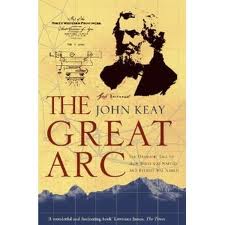
4. John Keay. The Great Arc:The Dramatic Tale of How India was Mapped and Everest was Named. Harper Collins Publishes, London. 2000.
The Great Indian Arc of the Meridian, begun in 1800, was the longest measurement of the earth's surface ever to have been attempted. Its 1,600 miles of inch-perfect survey took nearly fifty years. Hailed as "one of the most stupendous works in the history of science," it was also one of the most perilous. Snowy mountains and tropical jungles, floods and fevers, tigers and scorpions all took their toll on the band of surveyors as they crossed the Indian subcontinent carrying instruments weighing half a ton.
William Lambton, an endearing genius, had conceived the idea; George Everest, an impossible martinet, completed it. This saga of astounding adventure and gigantic personalities not only resulted in the first accurate measurement of the highest peak in the world but defined India as we know it and significantly advanced our scientific understanding of the planet.
http://www.goodreads.com/book/show/834383.The_Great_Arc
5. Kamala Markandaya. Nectar in a Sieve. Penguin Viking, 1954.
 Set in India during a period of intense urban development, is a fictional history of a marriage between Rukmani, youngest daughter of a village headman, and Nathan, a tenant farmer. Rukmani tells the story in the first person, from her arranged marriage to Nathan at age twelve to his death many years later.
Rukmani and Nathan love each other and their marriage begins in relative peace and plenty; however, a large tannery is built in the neighboring village and begins insidiously destroying their lives. As the tannery grows larger and more prosperous, Rukmani and Nathan struggle to feed their children and to pay the rent on the land that gives them life. Although matters continue to worsen, they quietly resign themselves to ever-increasing hardships—flood, famine, even death—and cling to their hopes for a better future.
6. Gita Metha. Snakes and Ladders: Glimpses of Modern India. Anchor, 1998.
 ‘Snakes and Ladders’ is a collection of essays on India. Captured in these essays is a time-period when India, post-independence, was struggling to establish its identity as a self-sufficient, progressive economy. The forward of the book explains the name given to the book and relates it to the Indian context. The book proceeds with essays on Indian politics, films, myths, popular beliefs, superstitions, love, leisure, décor and other very Indian tidbits. These combine beautifully to weave together the tapestry that is India.
http://www.book-review-circle.com/Snakes-And-Ladders-Gita-Mehta.html
7.Sam Miller, Delhi: Adventures in a Megacity. Penguin Books, 2009.
 This is an extraordinary portrait of one of the world's largest cities. Sam Miller sets out to discover the real Delhi, a city he describes as being 'India's dreamtown-and its purgatory.' He treads the city streets, making his way through Delhi and its suburbs, visiting its less celebrated destinations-Nehru Place, Rohini, Ghaziabad and Gurgaon-that most writers ignore. Miller's quest is the here and now, the unexpected, the ignored and the eccentric. All the obvious ports of call-the ancient monuments, the imperial buildings and the celebrities of modern Delhi-make only passing appearances. Through his encounters with Delhi's people-from a professor of astrophysics to a crematorium attendant, from ragpickers to members of the Police Brass Band-Miller creates a richly entertaining portrait of what Delhi means to its residents, and of what the city is becoming. Miller is, like so many of the people he meets, a migrant in one of the world's fastest growing megapolises and the Delhi he depicts is one whose future concerns us all. Miller possesses an intense curiosity; he has an infallible eye for life's diversities, for all the marvellous and sublime moments that illuminate people's lives. This is a generous, original, humorous portrait of a great city; one which unerringly locates the humanity beneath the mundane, the unsung and the unfamiliar. www.penguinbooksindia.com/delhi/about-delhi-aiam.html
 8. Rohinton Mistry, A Fine Balance. McClelland & Stewart, 2002.
The book exposes the changes in Indian society from independence in 1947 to the Emergency called by Indian Prime Minister Indira Gandhi. Mistry is generally critical of P. M. Gandhi in the book. Interestingly, however, Gandhi is never referred to by name by any of the characters, and is instead called simply "the prime minister". The characters, from diverse backgrounds, are all brought together by economic forces changing India.
 Ishvar and Omprakash's family is part of the chaamar caste, who traditionally cured leather and were considered untouchable. In an attempt to break away from the restrictive caste system, Ishvar's father apprentices his sons Ishvar and Narayan to a Muslim tailor, Ashraf Chacha, in a nearby village, and so they became tailors. As a result of their skills, which are also passed on to Narayan's son Omprakash (Om), Ishvar and Om move to Mumbai to get work, by then unavailable in the town near their village because a pre-made clothing shop has opened.
Maneck, from a small mountain village in northern India, moves to the city to acquire a college certificate "as a back-up" in case his father's soft drink business is no longer able to compete after the building of a highway near their village.
Dina, from a traditionally wealthy family, maintains tenuous independence from her brother by living in the flat of her deceased husband, who was a chemist.
At the beginning of the book, the two tailors, Ishvar and Omprakash, are on their way to the flat of Dina Dalal via a train. While on the train, they meet a college student named Maneck Kohlah, who coincidentally is also on his way to the flat of Dina Dalal to be a boarder. They become friends and go to Dina's flat together. Dina hires Ishvar and Om for piecework, and agrees to let Maneck stay with her.
http://en.wikipedia.org/wiki/A_Fine_Balance
9. Roy Moxham, The Great Hedge of India. Carroll & Graf Publishers, Inc., New York. 2001.
9. Roy Moxham, The Great Hedge of India. Carroll & Graf Publishers, Inc., New York. 2001.
“The Great Hedge of India is a book of history and travel. It tells of my chance discovery, in 1995, of a reference to a gigantic 1500-mile long hedge that the British had grown across nineteenth-century India. It describes my efforts to find its remains. There are no previous books about this hedge.
 More than a search for a piece of forgotten history though, the book describes a personal quest. Chapters on the history of the customs hedge, and tales of the men who built it, are interspersed with chapters on my hunt for its remnants. The book tells of my searches - at the beginning, merely on a whim; later as an obsession. It tells of how I looked for the elusive hedge, first in libraries and archives, and then on the ground in India. I took lessons in Hindi, and taught myself land navigation. As my researches progressed, I found that the hedge I had thought merely a piece of eccentricity was actually an instrument of oppression. It was used to collect a tax on salt set so high that many Indians suffered from salt starvation.”
http://www.roymoxham.com/page4.htm
10. Katherine Russell Rich. Dreaming in Hindi. Houghton Mifflin Harcourt, Boston & New York, 2009.
 Midway through Katherine Russell Rich’s year of learning Hindi in India, she takes a holiday with a fellow New Yorker whose direct manner of speaking unnerves her. “In a place swathed in veils—veiled references, displays, emotions, half the women—directness was shocking,” Rich writes in Dreaming in Hindi, her memoir of that tumultuous year. In recounting her education, she is regularly amazed at the ways second-language acquisition can change a person: cognitively, psychologically, socially. Things that once seemed familiar, like New York speech patterns, become strange; things once strange become familiar.
...The reader suspects that a more embittered, and interesting, soul lives beyond the page, but Rich chooses not to reveal that side of herself. Language, not people, is her primary concern.
No surprise, then, that Rich is at her best when discussing language science and history. Her journalistic skills shine in these sections, as she explores the process of acquiring first and second tongues, the cultural battles evident in etymology, and such fascinating cases as a Nicaraguan school for the deaf whose students developed, and over time passed down, their own unique system of signs. Rich cleverly applies this research to her experience in India, discovering, among other things, why her English worsened while she was learning Hindi and why the children at a local deaf school seem to know words their hearing teachers don’t. http://www.bookforum.com/review/4357
11. Arundhati Roy, The God of Small Things. IndiaInk, 1997.
11. Arundhati Roy, The God of Small Things. IndiaInk, 1997.

The story primarily takes place in a town named Ayemenem now part of Kottayam in the Kerala state of India. The temporal setting shifts back and forth from 1969, when fraternal twins Rahel and Estha are seven years old, to 1993, when the twins are reunited at age 31. Much of the story is written in a viewpoint sympathetic to the seven-year-old children. Prominent facets of Kerala life that the novel captures are Communism, the caste system, and the Keralite Syrian Christian way of life.
http://en.wikipedia.org/wiki/The_God_of_Small_Things
12. Vikram Seth, Suitable Boy. Harper Collins, 1993.
 Vikram Seth's novel is, at its core, a love story: Lata and her mother, Mrs. Rupa Mehra, are both trying to find -- through love or through exacting maternal appraisal -- a suitable boy for Lata to marry. Set in the early 1950s, in an India newly independent and struggling through a time of crisis, A Suitable Boy takes us into the richly imagined world of four large extended families and spins a compulsively readable tale of their lives and loves. A sweeping panoramic portrait of a complex, multiethnic society in flux, A Suitable Boy remains the story of ordinary people caught up in a web of love and ambition, humor and sadness, prejudice and reconciliation, the most delicate social etiquette and the most appalling violence.
http://www.goodreads.com/book/show/50365.A_Suitable_Boy
13. Paul Scott, The Raj Quartet: The Jewel in the Crown (1966), The Day of the Scorpion (1968), The Towers of Silence (1971), A Division of the Spoils (1975)
 The Raj Quartet are four novels in which Scott has transmuted contemporary history into fiction—the many forces at work in India over a period of five years, from the ‘Quit India’ motion of the Congress Committee in 1942 to the eve of Independence and Partition. Deeper than Scott's interest in history and politics, however, is his aim to probe the nature of human destiny, conveying a philosophy of life that shows man's destiny and moral sense sometimes at variance. He also focuses an ordinary human point of view on the world around him, valuing integrity and decency. …Scott's … novels constitute a major achievement in colonial, indeed, all, literature. Modern Asian Studies (2007), 41 : 797-847 Cambridge University Press
14. Abida Sultaan, Memoirs of a Rebel Princess. Oxford University Press, 2005.
 Born in 1913, Princess Abida Sultan was a unique and extraordinary personality. Unique because she remains the only ruler or heir of a major Indian princely state, Bhopal, to have migrated from India to Pakistan-sacrificing a life of comfort and security in pursuit of her ideals. Extraordinary because she was a woman of remarkable qualities and paradoxes.
 Her autobiography spans the glittering era of the princely states, in which Bhopal was second only to Hyderabad in importance among Muslim states, the end of the British Raj, and the emergence of Pakistan as a sovereign state. The center-piece of the book is her decision to sacrifice her roots and heritage to migrate to Pakistan where she lived in frugal and straitened circumstances in pursuit of Jinnah’s ideals.
Life in Pakistan forms the second half of the memoirs. She became Pakistan’s Ambassador to Brazil, and entered the political arena by supporting Miss Fatima Jinnah’s campaign against a military dictatorship. Throughout her life she remained a committed democrat and humanist, dedicated to her crusade against bigotry and the violation of human and democratic rights. www.indiaclub.com/Shop/searchresults.asp?ProdStock=13049
15. Padma Viswanathan, Toss of a Lemon. Tranquebar Press, 2008.
 Marriage at 10, in 1896, then motherhood at 14 and four years later a widow’s white sari — these are the determining events in the life of a Brahmin girl called Sivakami, the main character in Padma Viswanathan’s ambitious first novel. After her husband’s death, Sivakami packs away her silks and takes off the “gold medals of wifehood.” Then her head is shaved to make her as unattractive as possible. She will leave the house at night to bathe in the Kaveri River, but once the light comes she must not touch anyone, even her own children. “From dark to dark,” a Brahmin widow is held to be “so pure as to be an outcaste,” and Sivakami is the most observant of women. She will spend almost every day of the 60 years that remain to her within the rooms and courtyards of her dead husband’s house. Sunday Review of Books, New York Times, December 12, 2008.


